


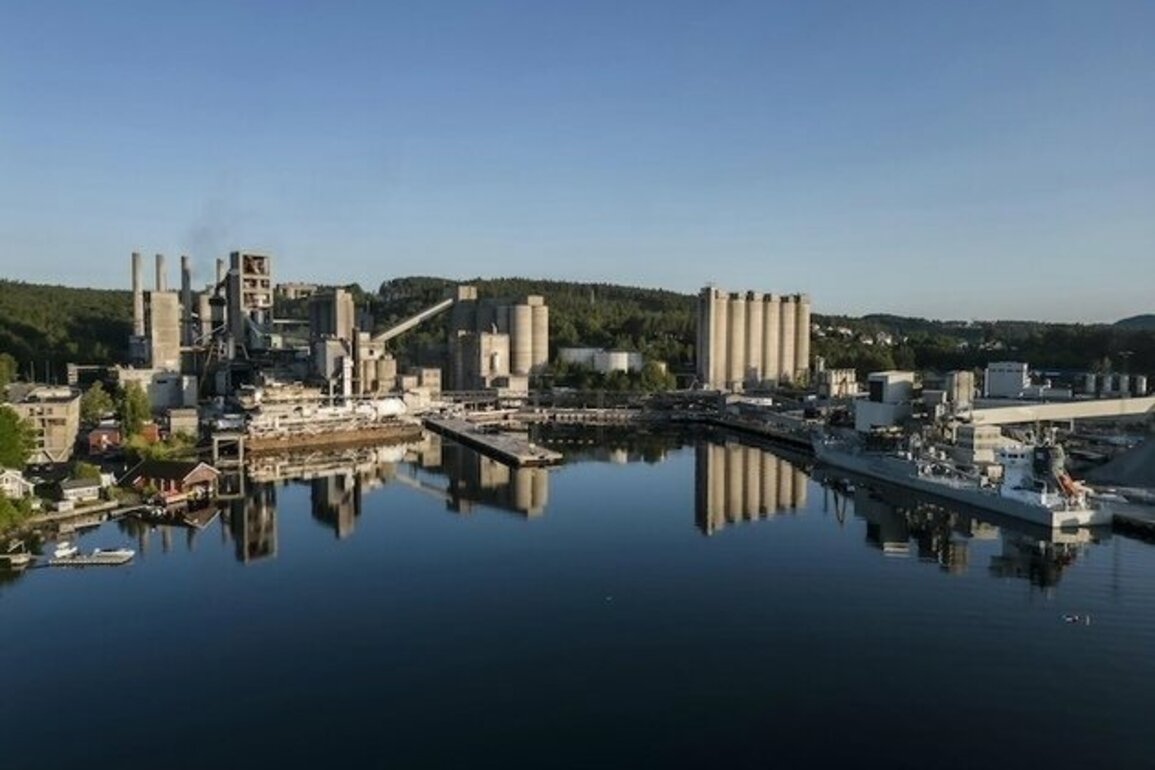
A German company has pre-sold its planned 2025 output of cement from a Norwegian facility using carbon capture, while a proposed CCUS project at an Edmonton facility remains in the planning phase.
"We are not going to produce the full amount this year as the plant is ramping up," Dominik von Achten, CEO of Heidelberg Materials, said of the company's Norway production.
"But we are sold out for 2025 and we continue to fill the order book."
Heidelberg's Brevik factory in Southern Norway is part of the country's Longship Carbon Capture and Storage Project, an initiative that is heavily subsidized by the Norwegian government and aims to develop infrastructure with capture carbon technology throughout the industrial supply chain. The Brevik factory's annual production capacity is expected to be just over one million tonnes of cement and will capture 400,000 tonnes of carbon dioxide each year-or about half of the facility's total emissions. About half of the cement will be marketed under Heidelberg's net-zero product brand, "evoZero," reports Reuters.
Cement production is considered a "hard-to-abate" sector where it is difficult to reduce emissions. E+E Leader called the Brevik factory's inauguration on June 18 a "pivotal moment" that will help address the 7% to 8% of global emissions attributable to cement production each year.
Carbon captured at the plant will be transported with purpose-built carriers to the Northern Lights facility in Norway. That facility opened last year and is co-owned by major fossil companies Shell, Equinor, and TotalEnergies.
"We know that the hard to abate sectors and the difficult industrial sectors that have no alternative need CO2 capture and storage as part of the solution," Norway's Energy Minister Terje Aasland told Reuters.
Meanwhile, Heidelberg Materials North America is negotiating with Canada's Department of Innovation, Science and Industry to develop a carbon capture, utilization, and storage hub near its cement facility in Edmonton, Alberta. The project would be North America's first full-scale commercial CCUS system in the cement sector and could remove up to one million tonnes of carbon dioxide per year.
The government has already committed $49 million to support the first phase of this project, and could provide additional funding of up to $226 million to support further development, the department said in March.
Source: The Energy Mix