

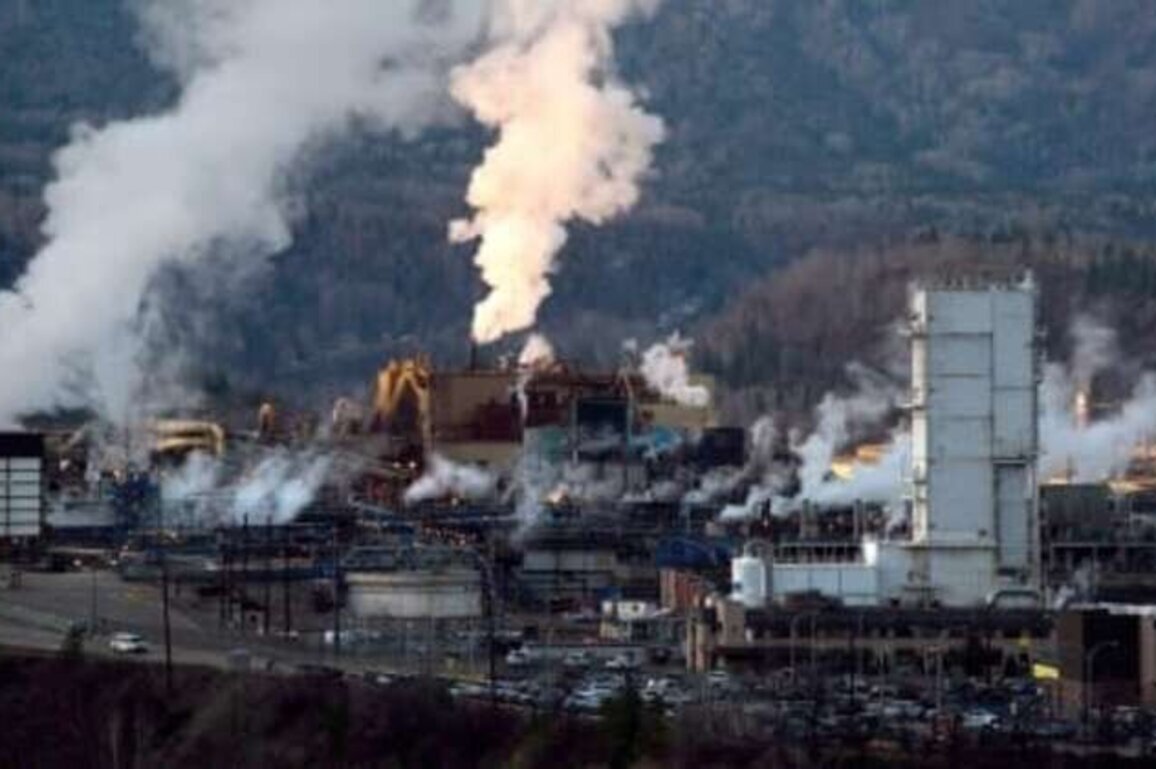
A company's claim that regulatory uncertainty prompted it to postpone an $8.25-billion oil sands expansion is the latest sign that the fossil industry isn't taking its climate pollution seriously, analysts say -or at very least, a hardball tactic to get a deal as the federal and Alberta governments tie down the details of the sweeping memorandum of understanding (MOU) they signed last fall.
On one hand, it was easy enough for Calgary-based Canadian Natural Resources Ltd. (CNRL) to postpone about $150 million worth of early engineering and design on a planned expansion of its mammoth Jackpine oil sands mine north of Fort McMurray, CNRL President Scott Stauth said last week. "It's simply about the engineering piece of it, so we have that flexibility and nimbleness to be able to move that project out or bring it back if necessary," he told CBC.
But Stauth still maintained the company was putting the investment on hold "until it gets more clarity around carbon pricing and methane emissions rules, which the company says have created an 'economic burden for long-term growth investments'," CBC writes.
"We're positive that the governments are working very diligently together. We're going to come up with a positive outcome," Stauth said. "We're just being very prudent from our perspective and ensuring that the outcomes from that are reviewed internally here to ensure that we can tell our investors that growth in oil sands is going to be economically competitive."
But that "clarity" [a word the industry often uses as a synonym for more lavish taxpayer subsidies-Ed.] may be less than a month away, as the federal and provincial governments work toward an April 1 deadline to tie down major elements of the MOU, including industrial carbon pricing and methane regulations. Officials on both sides are already saying they may need more time to seal the deal.
But "it's odd to publicly pause a major investment due to carbon pricing and methane policy uncertainty, when clarity on those very topics is expected in less than a month," Janetta McKenzie, oil and gas program director at the Calgary-based Pembina Institute, said in a release. "The ongoing negotiations between Alberta and the federal government include a table with oil sands producers, with the goal of reaching a formal trilateral deal. These topics can and should be addressed in these negotiations."
Those formalities didn't stop Conservative energy and natural resources critic Shannon Stubbs (CPC-Lakeland) from amplifying CNRL's complaint. "The truth is, anti-development Liberal laws are still in place and continue to push investors and builders to other countries with clearer rules and more predictability," she wrote on LinkedIn.
"This is laughable," responded Edmonton-based lawyer and advocate Orlagh O'Kelly. "The provincial regulatory system is basically a rubber stamp for oil sands development. The consultation system is defunct and unconstitutional (as is being argued in court). The federal government refused to do an impact assessment on CNRL's expansion. The industry is heavily subsidized. And now it's the Liberals' fault?"
"In an industry where bitumen sells for $50 to $60 per barrel and oil prices routinely move several dollars in a single day, those costs are essentially invisible," added Energi Media publisher Markham Hislop. "A policy measured in pennies per barrel cannot plausibly determine whether an $8-billion project proceeds, particularly in an industry where oil prices routinely swing by tens of dollars per barrel over the lifetime of a project"-or, this past week, in the span of 24 hours.
"Yet the claim that climate policy is killing investment has already begun circulating through Canada's energy debate," Hislop writes. "Politicians repeat it. Industry groups amplify it. Journalists uncritically report it."
Earlier, analysts weighed in on a familiar pattern in industry messaging after the country's alpha oil and gas lobby group, the Canadian Association of Petroleum Producers, issued its response [pdf] to a federal discussion paper on effective carbon markets. "The focus for Canada needs to be on enhancing the competitiveness of our key industries and positioning them to deliver the growth and diversification needed to strengthen our economy," President and CEO Lisa Baiton said at the time. The federal government's proposed industrial carbon pricing framework "will introduce increased complexity and cost across Canada's major industries, making us uncompetitive with global peers."
But a minimum carbon credit price of $130 per tonne, a key feature of the Canada-Alberta MOU, would add an average 50 to the cost of a barrel of oil, according to a new calculator released last week by the Canadian Climate Institute. That's the equivalent of one Timbit per barrel, the Institute says.
"We did the math: industrial carbon pricing has low costs for industrial facilities and minimal impacts on their competitiveness," the institute headlined.
Those numbers point to an industry now pulling back from a deeply controversial MOU that it greeted as a massive victory in late November, with Prime Minister Mark Carney receiving a standing ovation when he showed up at a Calgary Chamber of Commerce event to discuss the deal. The MOU envisioned at least one new pipeline to the West Coast, an "adjustment" to the federal ban on northwest coastal tanker traffic to give the pipeline access to Asian markets, a commitment to a $16.5-billion carbon capture and storage (CCUS) hub in northern Alberta, and 1.4 million barrels per day of increased oil production.
"There's a history of this with the oil industry," Environmental Defence Canada Executive Director Tim Gray told The Energy Mix in an interview. "When the times feel to them like the regulatory system is moving to constrain them, to put a price on carbon, restrict access to resources, or in some way force them to move in the direction of reducing their pollution impact, they put up propaganda campaigns to try to convince the public that they're part of the solution."
But now, "I think they very much feel that the gas in in their tank. Trump is in power in the United States, massively rolling back climate action and any kind of transition towards an electrotech future." So "I think you'll see them increasingly demanding that we as taxpayers pay for the pipeline, pay for CCUS, and no, we're not going to reduce our pollution. No industrial carbon pricing, no methane regulations, and you're just going to have to like it."
Etienne Rainville, policy and advocacy vice president at Clean Prosperity, said the $130-per-tonne industrial carbon price is reasonable, depending on the timeline for phasing it in. "It's actually fairly balanced and well-considered," he told The Mix. "It's something that would impose some cost on the industry, but it's a cost that we hope would be manageable" for them.
"And it's a cost that is mitigated by decarbonization, so it provides an opportunity for industry," he added. $130 starts to be in the range where technologies like CCUS are viable for mitigating some of those costs, and it's early to be too critical of that price from the industry's perspective" when key details like the timeline are still under negotiation.
That may be the reason the industry is suddenly talking down the MOU, Rainville added.
"The incentives for the industry are to negotiate as hard as they possibly can," he said. "It's the position of a rational actor to try to avoid or try to diminish the elements of the MOU... that are less desirable to them." So "it's not entirely surprising that folks are trying to pre-position their own perspective" on the way the industrial carbon price is implemented.
But those political calculations are "fundamentally wrong, and that's why it's so dangerous for Canadian political leaders to take [the industry's] assertions at face value and move in their direction in policy decisions," Gray said. Canada does currently depend on export revenue from oil and gas, "and we need to replace it. That's an all hands on deck problem. No one thinks we're going to shut down the oil sands tomorrow, but the idea of expanding it and increasing our reliance on revenue coming from oil and gas at this particular time is clearly economic suicide," with all indicators pointing to a faster global transition from fossil fuels to renewable electricity.
"Of course, the narrative the oil industry puts out is that the world will always need more energy," Gray added. "That's probably true. But it isn't going to be oil."
It helps us measure & strengthen the impact of our reporting.
Have more to say? Email [email protected]
Source: The Energy Mix