


Alberta Technology and Innovation Minister Nate Glubish has questioned a local town council's decision to allow a $10-billion artificial intelligence data centre and its 1.4-gigawatt gas power plant within town boundaries, saying it was "common sense" the project is not a good fit for a light industrial zone.
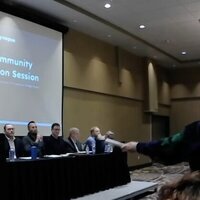
"If it is your view that a 1.4-gigawatt power plant is completely inappropriate for light industrial zoning, then there's a few folks in this audience that you should let know that," Glubish told a crowded town hall meeting in Olds, Alberta, a farming community about 90 kilometres north of Calgary, that included the mayor and several council members.
In an audio recording reviewed by The Energy Mix, Glubish said it was the council's responsibility to ensure the project "reflects the will of the community."
"I'm not the regulator, I'm not the AUC (Alberta Utilities Commission), and as the minister, it's not my job to approve or disapprove of a project," he said. "But what I would say is the municipality makes decisions on your behalf about land use and land planning, that's what you elect them to do, so it's probably best that they do that and not the province."
About 160 people attended the town hall, reported The Albertan. Mayor Dan Daley wasn't an invited speaker but did talk informally to a few residents afterward. Glubish told participants those conversations "can help to inform them as they're thinking about the land use and zoning, because that is in their jurisdiction to handle as a safeguard to protect you."
The technology minister, who's responsible for the province's AI data centre strategy, answered questions from the audience for almost two hours about data centre developments in the area. Residents in the town of 10,000 have organized in opposition to the project that Synapse Real Estate Group announced in January, 2026.
The AUC rejected [pdf] Synapses's first application March 6 due to "significant deficiencies," but the company filed a new proposal on April 3, Good Friday.
Multiple residents told The Mix they have tried unsuccessfully to have the council reconsider the decision to allow the project at the location, which lies less than 200 metres from the nearest homes. The Town of Olds, which did not reply to questions from The Mix about the Synapse project, has campaigned to attract data centres to the community.
An Olds resident for 18-years, Janey Olson, told The Mix in an interview that a group of locals who attended the Synapse zoning meeting had asked council to table the decision until they had more information. But the town went ahead anyway, converting a 300-acre parcel of farmland into a light industrial zone and allowing data centres as a discretionary use.
Glubish told the town hall that Olds municipal leaders had been asking his office for clarity on the rules and requirements.
"I apologize that it maybe has taken a little longer than you would have liked to for us to get them that clarity, but I think that we had a good meeting a week or so ago where we were able to talk about some of the specifics and, now we are in a position where we can provide that clarity," Glubish said.
All industrial projects will "honour our strict environmental controls and rules," he said, adding that "there's no shortcuts, no cutting corners, no exceptions."
However, the provincial environmental regulator has just given Synapse permission to skip an environmental impact assessment (EIA) for the project.
One audience member questioned the minister on the environmental exemption, to which Glubish replied: "That was a completely different and separate process from all of the other rules that I talked to you about today."
"We're simply saying, according to the legislation and regulation, this type of project does not require that additional bar and that additional process," Glubish said.
"I get that there's a lot of skepticism in the room, I hear that loud and clear," he added. "But what I want you to take away from today is we are going to make sure that all of you have the ability to participate in the very strict environmental review process that will still take place, so that you can provide all of your concerns to the decision-makers, the regulators."
In late March, one of those regulators, Darren Bourget, an Environment and Protected Areas regulatory assurance manager, told an Olds town council meeting that he didn't know "what this AI stuff is really all about." He later explained [pdf] that his department "regulates the protection of the quality of air, land, and water," focusing on substance releases, waste management, industrial releases, and land conservation and reclamation. The AUC, too, has environmental requirements that must be met for the power plant approval.
Another resident, Eric Carlson, who lives 400 metres away from the proposed site, said at the town hall that "everyone here has been told we're being listened to, but the developer's not listening to us, and our town isn't listening to us."
He raised concerns about public safety, in particular questioning the power plant's 600 backup diesel generators and the gigawatt of lithium ion batteries that will be located on the site.
According to the company's emergency management plan filed with the AUC, the project uses a lithium ion power supply and energy storage system that, unlike standard electrical fires, resists conventional fire suppression and generates highly toxic off-gassing. It could result in a "thermal runaway," where the extreme temperatures can create an extremely dangerous and destructive feedback loop.
"It really scares me. If they (the batteries) light on fire, we're evacuating, and do you think it's responsible to locate it next to a neighbourhood?" he asked. "Is it appropriate to put this much energy supply and Canada's biggest lithium ion battery next to 2,000 residences, including families, seniors, and low-income people?"
Glubish said he was "the wrong person to make that decision," but added: "What I can tell you is to have something a stone's throw from your house that's the same size as the Genesee power plant, which is an hour's drive from Edmonton, it certainly gives me cause to ask questions."
Glubish emphasized that "a press release is not a project," despite the Synapse data centre being listed on the provincial government's website as a "major project."
"And I don't think the Synapse folks did anybody any favours by rushing to do a press release," he said, though Glubish himself posted a celebratory LinkedIn announcement about the project two months ago.
"A ten billion dollar data centre. Biggest in Canada. That's a validation of our strategy, a verification of Alberta as a prime global destination for data centre investments. And we're just getting started!", Glubish wrote in his post.
Michael Brown, who lives about 600 metres from the proposed site, asked the minister, "would you like to have one in your town without having anything you can do about it?"
"Obviously, the answer to that is no," Glubish replied. "I would want to make sure that I was involved in the process and have ample opportunity for input, and as I mentioned, there's multiple opportunities for that."
Brown then asked him "why can't you as a government say, 'you know what, we're not going to build giant power plants right in the middle of Alberta towns.' You guys have the power to do that and you should do that. So why aren't you?"
Glubish said he was "very persuaded" by the argument "that a 1.4-gigawatt power plant that's 300 metres from your house doesn't make any sense."
"I'll do a little homework to see whether or not there is a need for the province to put something hard-coded into provincial legislation to deal with that," he said, adding that the government hasn't already done so because they "didn't think it was going to be needed," and "it's only because this one project happened to come out of the woodwork."
"They never consulted with our team to say, hey, do you think this is a good idea? They just came up and said, we're gonna do this," Glubish added.
Rebecca MacIntosh, another Olds resident, said "nobody wants to put their child to bed beside a gas plant on that scale."
She said the data centre would be located 300 metres from her back door and that she had attempted to speak to municipal leaders "numerous times."
"We've been labelled conspiracy theorists, and I really hope you're the right person to begin to influence these changes happening," she told Glubish.
Meanwhile, another data centre is also planned for the small town. It was announced in December by two European companies, Data District Inc. and Technologies New Energy plc. That development process will start sometime this year. The companies said they are also building three others in small towns across Alberta.
Premier Danielle Smith posted on her Facebook page that the $1.2 billion investment in the four data centres requiring another full gigawatt of power showed "the renewed Alberta Advantage is here."
It helps us measure & strengthen the impact of our reporting.
Have more to say? Email [email protected]
Source: The Energy Mix